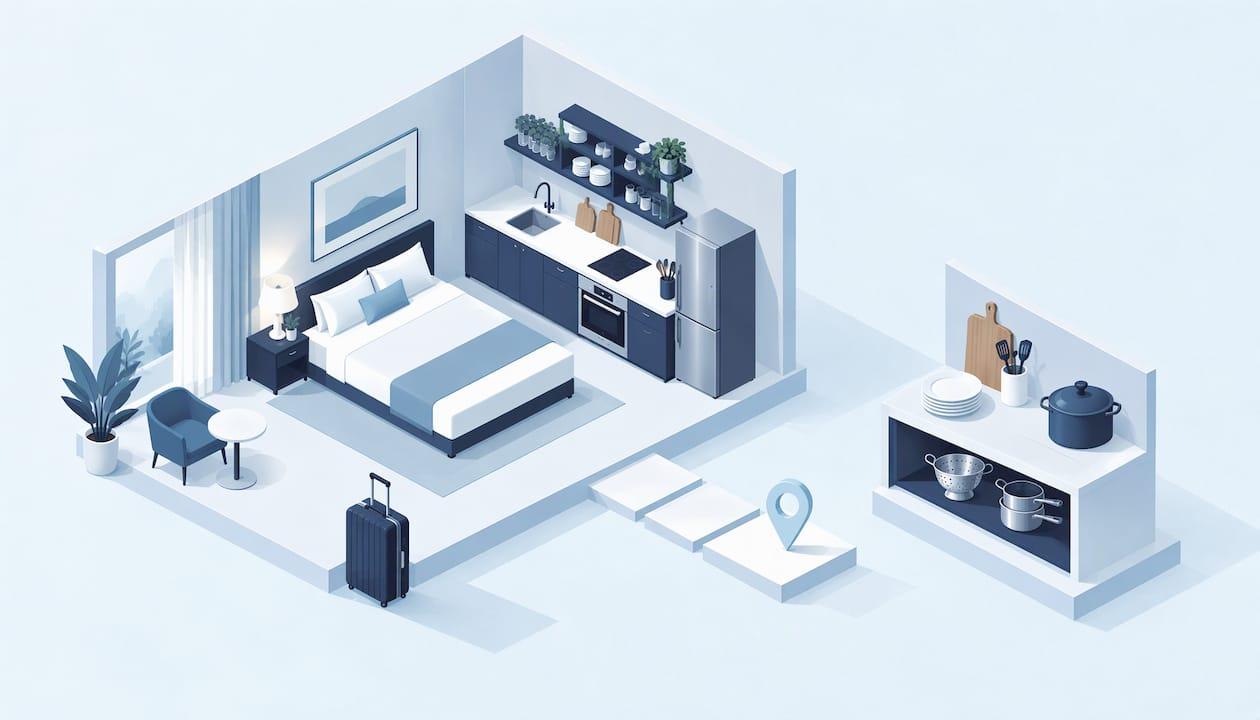
To verify a hotel kitchen before booking, confirm four things: the exact room type has the kitchen, the cooking surface is a real stovetop or hob (not just a microwave), the equipment list names what you need, and the hotel has confirmed it in writing. The word "kitchenette" promises very little on its own, so the fastest route is a listing that has already done the checking. That is what we built Hotelkitchens to be: every listed room is checked for a cooking surface by both a person and an AI model, with the evidence shown on the listing.
This guide walks through the full routine for when you are checking on your own, and shows where the work goes wrong.
TL;DR
- "Kitchenette" has no fixed meaning. It can be a mini fridge and microwave, or a two-burner stove with a sink and cookware.
- Verify the exact room type you are booking. A kitchen somewhere in the building does not mean your room has one.
- Ask a precise question with your dates and room type, and get the answer in writing, including appliances and extra fees.
- Read the newest reviews and guest photos for repeated mentions of the kitchen, not single outliers.
- If the room does not match, document it on arrival and raise it before you leave.
Table of Contents
- Why "kitchenette" is not enough
- Step 1: Confirm the exact room type
- Step 2: Check that there is a cooking surface
- Step 3: Read the equipment list, then the photos
- Step 4: Use recent reviews and guest photos
- Step 5: Ask the hotel a precise question
- Step 6: Get it in writing
- A quick checklist you can copy
- What to do if the kitchen is not what you were told
- Where our verification fits
- Our view
- FAQ
- Sources
Why "kitchenette" is not enough
Hotels use two words for in-room cooking, and neither is regulated. A guide to hotel brands with kitchens notes that the terms have no clear definitions. A full kitchen generally means a cooktop, full-size refrigerator and sink, often with a microwave, dishwasher, dishes and cookware. A kitchenette usually lacks a cooktop, dishwasher or full-size fridge, and typically has a sink, microwave and mini fridge.
"Usually" is the problem. Some rooms sold as kitchenettes have a kettle and a small fridge. Others have a two-burner stove. If your plan is scrambled eggs and pasta for a family of four, those are different rooms.
So before you look at any room, decide what you need to cook. A simple way to do it:
| Your plan | Minimum setup to confirm |
|---|---|
| Breakfast and snacks | Fridge, microwave, sink, plates and cutlery |
| Reheating leftovers, simple dinners | Microwave, sink, fridge large enough for groceries, basic cookware |
| Real cooking all week | Cooktop or hob, pots and pans, utensils, a full-size or large fridge |
| Baby food or dietary needs | Fridge space, a sink, a cooking surface or kettle, plus a way to wash up |
Write your own line down. Every step below checks against it. Our guides on what a kitchenette actually means and which appliances you really get go deeper on each item.
Step 1: Confirm the exact room type
This is where most mix-ups start. Amenities can differ by room, building, floor and category. A kitchenette in a suite does not mean the standard room has one.
Booking platforms add to the confusion. One guide to auditing a Booking.com listing explains that features such as a kitchenette are attached to individual room types, so a property-level fact can be read as a promise for every room. A traveler on Travel Stack Exchange described a listing marked "kitchen" that turned out to be a shared kitchen. The responder pointed out that the platform's filter shows only "Kitchen", with no private or shared distinction.
What to do:
- Open the room-level page, not the hotel overview, and read the amenity list for the specific room name you will select.
- Look for "private kitchen" or "in-room kitchenette", not just "kitchen facilities" or "shared kitchen".
- Ignore marketing names. "Deluxe" and "Suite" mean different things at different hotels. Square footage and the floor plan tell you more.
- Note the exact room name so you can quote it later.
The weak point of this step is time. Doing it across ten hotels means ten different layouts and ten different ways of listing amenities. On our site, every listed room is held to one kitchen standard, so the room types shown are the ones with cooking amenities.
Step 2: Check that there is a cooking surface
A microwave and a mini fridge are common. A cooking surface is not. A hotel's own guide to finding kitchenettes makes the same point: hobs and ovens are uncommon enough in hotel kitchenettes that guests planning self-catered dinners should check for them specifically.
Look for exact wording in the room's amenity list: "cooktop", "stovetop", "two-burner stove", "induction hob". A guide on confirming a stove before booking suggests checking the room amenities list for that kind of wording, or phoning the front desk. It also warns that online photos often show a representative room that may include upgrades not in every unit.
If the listing says only "kitchenette" and shows no burners in the photos, treat it as no cooktop until the hotel says otherwise. Our walkthrough on confirming a stove before you book covers the wording to look for.
This is the check our verification is built around. We confirm a cooking surface, not just a microwave, and we show the evidence on each listing. You can read how we verify hotel kitchens for the details we publish.

Step 3: Read the equipment list, then the photos
A stove without a pan is half a kitchen. Once you know there is a cooking surface, check the rest of the setup:
- Fridge size: mini fridge, under-counter, or full-size.
- Sink, and whether there is dish soap and a sponge.
- Pots, pans, plates, cutlery, glasses, a knife and a cutting board.
- Coffee maker, kettle or toaster, if you care.
- Oven, dishwasher or freezer, which should not be assumed.
The same plain-language guide notes that most kitchenettes include a basic frying pan, pot and utensils, though quality varies by brand. "Basic" is not a guarantee, so if you need a lid, a baking dish or a can opener, ask. Our page on what utensils you actually get lists what is typical.
Then look at the photos with a purpose. Professional photography is shot to sell. Look for burners, a sink in the same frame, counter space, and a fridge you can judge the size of. A close-up of a coffee pod machine is not evidence of a kitchen. We wrote about what hotel kitchen photos show and what they hide if you want the longer version.

Step 4: Use recent reviews and guest photos
Reviews are the closest thing to an inspection by someone who has stayed there. Use them narrowly.
- Sort by newest, not by rating. A pre-arrival research framework suggests reading the 20 most recent reviews across at least two platforms.
- Search the reviews for "kitchen", "stove", "cooking", "pans" and "fridge".
- Look for patterns. Five recent reviews mentioning the same problem is a signal, while one angry review is not.
- Prefer guest photos over hotel photos, and compare them with the room's listing photos.
Reviews also catch what listings cannot, such as a renovation that removed the stove, or a burner that has not worked for months. If the stove is mentioned in reviews from the past year, you can trust it more than a listing that has not changed in years.
On our site, guests rate the listed hotels, so you can pick top-rated options once the kitchen has been verified.
Step 5: Ask the hotel a precise question
Asking "Do you have a kitchen?" gets you a yes that means little. Ask about your room, your dates and your needs. For example:
I have a reservation for [exact room name] from [check-in] to [check-out]. Please confirm the room has a cooktop, a full-size refrigerator, and cookware for four people. Are there any cooking restrictions, deposits or extra fees?
Cover these points:
- Appliances: burners (how many), oven, fridge size, microwave, dishwasher.
- Cookware: pots, pans, plates, cutlery, and whether they are replaced or washed.
- Cooking rules: some hotels restrict frying or strong-smelling foods, according to a family hotel checklist. It also suggests asking whether housekeeping cleans the kitchenette daily or only at the end of the stay, and whether extra charges apply.
- Fees: nightly or one-time charges, refundable deposits.
If you are asking for a fridge or microwave to be added to a room that does not have one, one guide to requesting these appliances advises asking whether it is guaranteed or subject to availability, noting the name and department of the person who answers, and reconfirming a day or two before arrival.
For the cooking-rules side, see our guide to cooking in a hotel room.
Step 6: Get it in writing
A phone call fades. A written confirmation does not. The Wisconsin Department of Agriculture, Trade and Consumer Protection's lodging reservation guidelines advise requesting a written confirmation that itemizes the amenities, and it names "appliances, kitchenette, etc." along with the dates, rates, bed types and cancellation policy. It also advises getting a confirmation number and following up if written confirmation does not arrive on its own.
In practice:
- Ask the hotel to reply by email with the room type and the kitchen equipment listed.
- Save the reply and screenshot the listing page as it looks on the day you book.
- Carry both on your phone for check-in.
The time to do this is before you pay, or right after you book if the cancellation window is still open. Keep an eye on the free-cancellation deadline.
A quick checklist you can copy
Our longer hotel kitchen checklist has more, but these are the ones that matter most:
| Check | Where to look | Done when |
|---|---|---|
| Right room type | Room-level page | You have the exact room name |
| Private, not shared | Amenity list, reviews | Wording says in-room or private |
| Cooking surface | Amenity list, photos | Burners or hob named |
| Fridge and sink | Amenity list | Size and sink confirmed |
| Cookware | Hotel reply | Pots, pans, plates, cutlery confirmed |
| Rules and fees | Hotel reply | Restrictions and charges known |
| Written proof | Email, screenshots | Saved on your phone |
What to do if the kitchen is not what you were told
Even careful guests sometimes arrive to a room that does not match. Do these in order, and do them on the first day:
- Photograph or film the kitchen area and the missing items. The European Consumer Centres advise taking photos or videos as evidence and looking for a solution before you leave. Options include another room, a price reduction, compensation or a credit note.
- Go to the front desk with your written confirmation and the listing screenshot. Ask for a room that matches.
- If you booked through a platform, contact its customer service as well as the property. The same guide recommends this.
- Do not wait until checkout. A full refund is harder once the stay is well under way.
That is why the checks above come first. Documenting your confirmation before you travel is what makes this conversation short.
Where our verification fits
The routine above works, but it takes real time per hotel: room pages, photos, reviews, emails, screenshots. Our directory exists to take most of it off your hands. Each listed room has been checked for a cooking surface by a person and by an AI model, the evidence is shown on the listing, and only rooms that meet one kitchen standard are published.
You can start from the full directory of verified hotels, browse all locations, or go straight to a state such as Minnesota, Washington or Michigan.

If you are booking for a week or more, or traveling with children, start with a verified room and use the steps above for the final confirmation with the hotel.
Our view
Most travelers do not get burned by a hotel that lies. They get burned by a word that means three different things. "Kitchenette" is the clearest case: the same label covers a microwave on a shelf and a full two-burner setup.
That is why we hold every listing to one standard: a cooking surface, not just a microwave. A person and an AI model both check each room, and we show the evidence on the listing, so you can see which room type has the kitchen before you click through.
For families and for anyone staying more than a few nights, the savings from cooking a few meals are real, but only if the stove is actually there. A verified room turns the question "does it have what I need?" into something you can see.
Ross
FAQ
How do I know if a hotel room has a real kitchen or just a kitchenette?
Look at the room's amenity list for a cooktop, stovetop or burners, plus a sink and fridge. A kitchen generally has a cooktop and full-size fridge, while a kitchenette usually has a sink, microwave and mini fridge. If the listing does not name a cooking surface, ask the hotel in writing.
Should I call the hotel or message it?
Either works, but follow a call with an email so you have the answer in writing. Give your room name and dates, and ask about appliances, cookware, restrictions and fees. Save the reply along with your booking confirmation.
Can I trust the photos in a listing?
Use them as a starting point. Photos often show a representative room, and upgrades may not be in every unit. Compare them with recent guest photos and the amenity list for your exact room type.
Is it allowed to cook in a hotel room that has a kitchenette?
Generally the in-room equipment is there for use, but some hotels set rules on frying or strongly scented foods. Ask when you confirm the room, and read our guide to cooking in a hotel room.
What if the kitchen is shared?
A shared kitchen is not in-room cooking. Look for the word "private" in the room's amenity details, and check reviews for mentions of a shared space. If you arrive to a different setup, document it and raise it with the property and the booking platform right away.
Sources
- Hotel brands with kitchens and kitchenettes: definitions
- How to audit a Booking.com hotel listing
- Travel Stack Exchange: shared versus private kitchens on Booking.com
- Hotel room with kitchenette: names and what to expect
- How to evaluate a hotel before booking
- Family hotels: what to verify before booking
- Can you request a fridge or microwave in your hotel room
- Wisconsin DATCP lodging reservation guidelines
- European Consumer Centres: accommodation booking problems