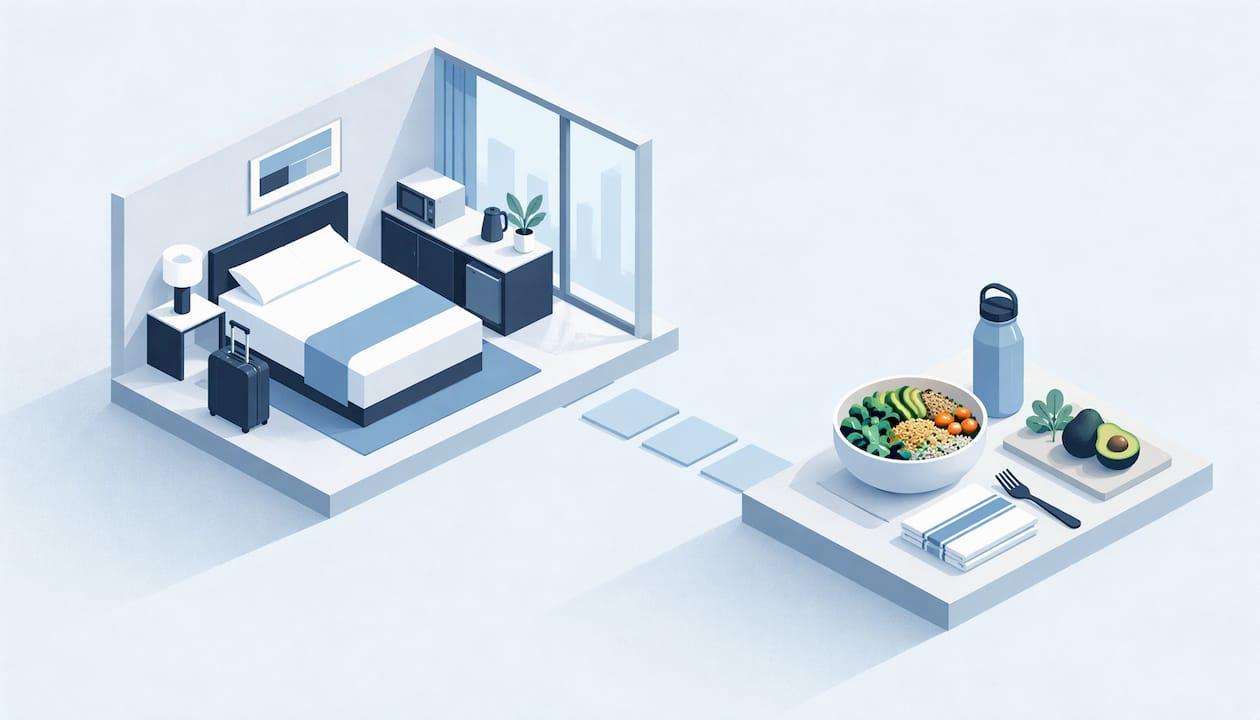
Cooking on a business trip works when you book a room that has a real cooking surface, not just a microwave. Everything else, the meals, the packing list, the savings, follows from that one choice. At HotelKitchens we list only hotel rooms where a human and an AI model have both confirmed a cooking surface, with the evidence shown on every listing, so you know what you are walking into before you book.
TL;DR
- Decide how you want to eat first: a microwave and mini fridge cover breakfasts and reheated dinners, a cooktop covers real hot meals.
- Book the room type, not the hotel. Kitchen equipment changes from one room category to the next, even inside one building.
- Pack a small kit (knife, bowl, utensils, dish soap, a lidded container) and buy groceries near the hotel.
- Keep food safe: wash hands for 20 seconds, never leave prepared food out for more than 2 hours, and use refrigerated leftovers within 7 days.
- Skip fish and garlic-heavy dishes in a shared-air room, and ask the property what cooking it allows.
Table of Contents
- Why cook on a business trip at all
- Know what "kitchen" means before you book
- How to plan a business trip around cooking
- What to pack
- Meals that work
- Food safety in a small kitchen
- What it saves you
- Our perspective
- Find a room with a verified kitchen
- FAQ
- Sources
Why cook on a business trip at all
A week on the road usually means three restaurant meals a day, and by Thursday most people are tired of them. Cooking even two of those meals changes the trip: you eat when you finish work instead of when the kitchen is open, you control what goes in the dish, and you stop paying restaurant prices for a bowl of oats or a plate of eggs.
The stay length matters. For one night, a grocery run is not worth it. From about four or five nights, a room with a refrigerator and a way to heat food pays for itself in time and money. On stays of several weeks, a proper kitchen turns the hotel into something close to an apartment, which is why many project assignments and relocations use extended stay hotels with kitchens.
Cooking also fits the health side of travel. Duke Health's wellness blog suggests asking for a mini fridge and microwave so you can keep yogurt, string cheese, cut vegetables, hard-boiled eggs and similar foods on hand, and use the microwave for oatmeal, rice pouches or a baked potato.
Know what "kitchen" means before you book
Hotel listings use the word loosely. Three setups cover almost everything you will see:
| Setup | What is usually in the room | What you can cook |
|---|---|---|
| Fridge and microwave only | Mini fridge, microwave, sometimes a coffee maker | Reheated food, oatmeal, eggs in a bowl, potatoes, simple one-bowl meals |
| Kitchenette | Small fridge, microwave, sink, often a cooktop or burners | Pasta, stir-fries, soups, pan-cooked eggs, one-pot dinners |
| Full kitchen | Full-size fridge, stovetop, often an oven, counter space | Almost anything you would make at home |
The trap is the middle row. A kitchenette at one property means a two-burner stove, and at another it means a mini fridge and a microwave under the same name. If you want to sauté or boil, you need to see a cooking surface confirmed for the exact room, not the property. Our guide to what a kitchenette actually means walks through the differences, and the one on kitchen appliances you really get in the room covers what is typically supplied.
Cookware is a separate question. Even in a room with a stove, pots, pans and knives are sometimes supplied only on request, so read up on hotel kitchen utensils before you decide how much to pack.
Match the room to the meals you want
Write down the three dinners you would actually cook. If they are a rotisserie chicken with rice and a salad, a microwave is enough. If they include a pasta with sauce, a stir-fry or a pan of fish tacos, you need burners. If you plan to bake, you need an oven, and that points to a full kitchen. You can browse each type separately: hotels with kitchenettes and hotels with full kitchens, each filtered to rooms with a verified cooking surface.

How to plan a business trip around cooking
1. Choose the location for the work first
Start from where your meetings, site or office are, then look for kitchen rooms within a short drive. A kitchen is worth little if you add 40 minutes of commuting. Our location search lets you start from the city you are visiting and see which listed hotels have verified kitchens there.
2. Check the room, not the property
Amenity lists are a starting point. Equipment, storage and workspace differ by room type, so confirm the exact category and dates you are booking. On our listings, kitchen evidence is shown at the room level, and only rooms meeting a single kitchen standard are published, so you see which room types have cooking amenities. If you want to know how that check works, see how we verify hotel kitchens.
3. Ask what is allowed
Hotels set their own rules on cooking in rooms. Some properties ban any appliance you bring beyond what they supply, and some charge fees for cooking with portable appliances. A room with a built-in stove is designed for cooking, so this is rarely an issue, but a travel hot plate, rice cooker or toaster oven is a different story. Do not plan on bringing one without asking the property first. Also keep the room's fire safety in mind: never leave a cooktop unattended.
4. Plan the first night
You will land tired, so plan one meal that needs no shopping: a rice pouch, a can of beans, a bag of salad, or something you bring. Then do a grocery run the next morning. Grocery delivery or a pickup order placed from the airport works for many travelers.
5. Plan the whole week, loosely
Choose two or three base ingredients that stretch across several meals, such as a roast chicken, a dozen eggs, a bag of rice and some vegetables. Meal planning with limited equipment is easier when you keep it simple, and a piece on eating well when you are busy is a good companion for building routines that hold up during long workdays.
What to pack
A good kit weighs very little. The University of Minnesota Extension lists the basics for a room with a fridge and microwave: a spoon, fork, knife, bowl, plate, can opener, a microwave-safe bowl with a cover, dish soap and paper towels.
For a business trip, a practical list looks like this:
- A small paring knife with a cover and a thin cutting board (a knife must go in checked luggage when you fly)
- One non-breakable bowl and plate that can go in a microwave
- A fork, spoon and a can opener
- A small bottle of dish soap and a sponge
- A few zip bags or lidded containers for leftovers
- A little spice jar with salt, pepper and one or two spices you like
Leave bulky appliances at home. If your room has a full kitchen, you will probably find that you pack even less, since the property supplies much of the cookware. Check the room's listing and the property's information before you leave.
Meals that work
In a room with a fridge and microwave
The University of Minnesota Extension suggests scrambled eggs cooked in a bowl (stir after 45 seconds), yogurt parfaits, bean soup from canned beans, tomatoes and corn, tortilla roll-ups, tuna mac and a microwaved potato topped with chili. Food Network's hotel guide adds mug mac and cheese, microwave-rice grain bowls and a rotisserie chicken stretched into quesadillas, tacos and next-day chicken salad.
A solid pattern is a cooked protein, a quick starch and a raw vegetable. Rotisserie chicken, a rice pouch and a bagged salad take five minutes and need one bowl.

In a kitchenette or full kitchen
This is where business travel cooking gets good. With two burners and one pan you can make:
- Breakfast: eggs and toast, or oatmeal with fruit and nuts you keep in the room
- Dinner in 20 minutes: pasta with a jar of sauce and a bag of spinach, or a stir-fry with frozen vegetables and rice
- Sheet-pan or one-pot meals: sausage and vegetables, a chicken thigh and potato bake in a full kitchen, or chili that gives you lunch for the next day
- Packed lunches: cook once, portion into containers, and take them to the meeting or the site
The rule that holds everywhere is to minimize cleanup. A single pan and a single bowl, washed right after the meal, keep the room usable and tidy.
Watch the smell
A hotel room has no exhaust hood. Food Network reports that after one guest microwaved poached salmon at a motor lodge, the room needed three days to air out before it could be rented again, and it advises against fish, shellfish and strong foods like garlic. Pick mild dishes, crack a window if you can, and take out the trash daily.
Food safety in a small kitchen
Small rooms need the same hygiene as a home kitchen. The University of Minnesota Extension advises:
- Wash hands with soap under running water for 20 seconds before preparing food, or use an alcohol-based sanitizer if you have no water.
- Rinse produce under running water, without soap or bleach.
- Do not eat prepared food that has been left at room temperature for more than 2 hours.
- Store food in closed containers, away from heat, chemicals and garbage.
- Use or throw out refrigerated leftovers within 7 days.
All of that is in its guide to cooking without a kitchen. Add two common-sense microwave habits: use only containers made for microwave use, and keep metal out of the oven. If anything ever catches fire, keep the door closed, switch the appliance off and tell hotel staff. If you have a medical condition, a pregnancy or a food allergy, talk to your doctor about what is safe to keep and reheat in a room.
What it saves you
A meal budget is easy to overshoot on the road. Business travelers who are reimbursed on a daily meal allowance often find restaurant dinners eat the whole amount, and a room that lets you cook breakfast and some dinners leaves more of it in your pocket. Rather than quote an average that will be out of date by next season, run your own numbers: add up what you normally spend on meals in a travel week, then compare it with a grocery bill for the same days. Your employer's travel policy will tell you what is reimbursed, and you should check it with your finance or travel team before you plan around groceries.
Our perspective
We built HotelKitchens around one irritation: a room described as having a kitchen that turns out to have a microwave and nothing else. For a business traveler that gap decides whether you eat a proper dinner at 8 pm or order room service again.
That is why we publish a room only when a cooking surface has been confirmed by a human and an AI model, and why we show the evidence on the listing. A microwave is useful, but it is a different tool from a burner, and the two should never share a label.
Our advice to anyone planning to cook on the road: choose the room by the meals you want to make, book the room type that has the equipment, and keep your packing list short. The rest is a grocery store and ten minutes.
Ross
Find a room with a verified kitchen
If you want to cook on your next trip, start with a room where the cooking surface is already confirmed. HotelKitchens lists hotels with kitchens and kitchenettes, each with guest ratings, room-level kitchen evidence and a dual human and AI check, so you can pick a top-rated option for the city you are working in. Search verified hotels with kitchens and kitchenettes and book through the listing.

FAQ
Can I cook in a regular hotel room without a kitchen?
You can make simple meals if the room has a mini fridge and a microwave, such as eggs in a bowl, oatmeal, a baked potato or a rice-pouch bowl. You cannot do real stovetop cooking. For that, book a room with a verified cooking surface, and ask the hotel before bringing any appliance of your own.
What should I look for in a hotel if I want to cook on a business trip?
Look for the room type that has a cooktop or burners, a fridge big enough for several days of food, a sink and counter space. Confirm it for the exact room and dates, since equipment varies by room category. Our listings show kitchen evidence at the room level to make this easy.
What food is easy to keep in a hotel mini fridge?
Yogurt, milk, string cheese, pre-cut vegetables, hard-boiled eggs, lunch meat and leftovers all work well, according to Duke Health. Keep prepared food no more than 2 hours at room temperature and use refrigerated leftovers within 7 days.
Is it worth cooking for a stay of only a few nights?
For one or two nights, simple fridge-and-microwave meals are enough. From about four or five nights, a room with a kitchenette or full kitchen starts to make sense, and for stays of weeks it is the most practical choice.
Sources
- Cooking without a kitchen, UMN Extension
- Meals for Hotel with Fridge and Microwave, Food Network
- Meal Planning for Travelers, Duke Health
- Eating on the Go: How to Eat Well and Mindfully When You're Busy