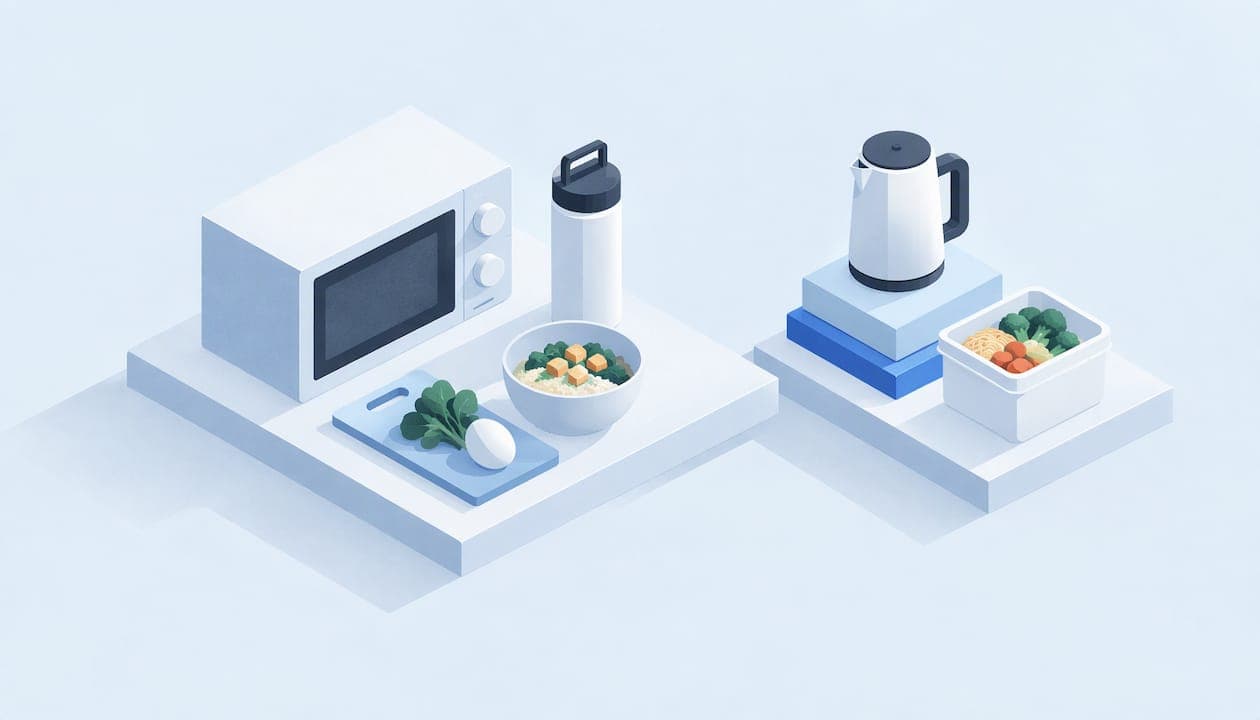
The easiest hotel room meals depend on one thing: the equipment you actually have. With no appliance at all, you can assemble sandwiches, wraps and yogurt bowls. With a kettle, you can make couscous and instant noodles. With a microwave, you can make baked potatoes, egg mugs and rice bowls. With a kitchenette and a cooking surface, you can make one-pan pasta, eggs and chicken cutlets in about 15 minutes. This guide gives you meals for each setup, rough costs, a short packing list and the food safety rules that keep a hotel-room kitchen trouble-free.
TL;DR
- Match the meal to your equipment: no-cook in any room, hot-water meals with a kettle, microwave meals only where a microwave is supplied, and stovetop meals in a kitchenette.
- A microwave potato, a couscous bowl and one-pan pasta cover most dinners with very few dishes.
- Keep cold food at 40°F or below and never leave perishables out for more than 2 hours (1 hour above 90°F).
- Pack a small kit: a bowl, a fork, a knife, a sponge and a few spices, so even a bare room works.
- If cooking matters to your trip, book a room where a cooking surface is confirmed before you arrive.
Table of Contents
- Start With the Equipment, Not the Recipe
- No-Cook Meals That Work in Any Room
- Kettle Meals: Couscous, Noodles and Rice
- Microwave Meals With a Mini Fridge
- Kitchenette Meals: One Pan, One Burner
- What to Pack for Easy Hotel Room Meals
- Keep Food Safe in a Hotel Room
- Check the Rules Before You Cook
- How Much You Can Save
- Book a Room Where You Can Actually Cook
- FAQ
- Sources
Start With the Equipment, Not the Recipe
Most lists of hotel room recipes fail because they assume a stove. Before you buy groceries, work out which rung of this ladder your room sits on:
- Nothing but a sink: no-cook meals only.
- Kettle or coffee maker: hot-water meals.
- Microwave and mini fridge: reheated and steamed meals.
- Kitchenette with a burner or hot plate: real one-pan cooking.
One editorial team that writes on this topic advises matching the meal to the equipment the hotel has confirmed: no-cook meals in any room, kettle meals only with a heat-safe container, and microwave meals only when a microwave is supplied or approved. It also reminds travelers to check storage before buying perishable food, and notes that a minibar is not automatically a refrigerator. Confirm what the room has, then shop.
A microwave alone is not a kitchenette. If you want to sauté, boil or fry, you need a cooking surface, and that is the detail we check on every listing. More on that below.
No-Cook Meals That Work in Any Room
These need a cold spot, a knife and a bowl. They are the safest bet when you are not sure what the room offers.
- Wraps and sandwiches: tortillas with hummus, sliced turkey, cheese and spinach. A baguette with butter and ham is about as simple as dinner gets.
- Yogurt and fruit bowls: single-serve yogurt cups, granola and a banana or berries.
- Overnight oats: oats, milk and chia in a jar in the mini fridge. They are ready by morning.
- Peanut butter and jelly: a staple for families who want to skip at least one café stop. One family-budget article describes parents stocking mini-fridges with fruit, yogurt cups, bread and PB&J supplies for exactly this reason.
- Snack plates: cheese, crackers, cucumbers, cherry tomatoes, olives and sliced apples.
- Blended breakfasts: if you carry a small travel blender, smoothie meal prep tips show how to portion ingredients so a morning blend takes minutes.
Keep a roll of paper towels and a few zip-top bags nearby. They handle most of the cleanup.
Kettle Meals: Couscous, Noodles and Rice
A kettle gives you boiling water, and boiling water covers more meals than you would expect. A Times of India roundup of kettle foods lists instant noodles, couscous and instant masala rice. The method is the same each time: pour boiling water into a separate heat-safe bowl, then cover. Noodles take about 3 to 5 minutes, couscous about 5, and instant rice a few minutes.
Use the kettle for water only. Unless the property says otherwise, do not add noodles, soup, plant milk, cans or food packets to the kettle itself. Pour the water into a clean bowl instead. That keeps food residue out of equipment the next guest will use.
A Six-Minute Couscous Bowl
One food blogger describes a Mediterranean couscous bowl made with an electric kettle: one cup of boiling water over one cup of dry couscous with salt and olive oil, covered for five minutes. Then stir in sun-dried tomatoes, cucumber, feta and Kalamata olives. The author puts it at roughly $3.50 per large portion.

You can vary it with canned chickpeas, a drained can of tuna, or leftover rotisserie chicken. Couscous packs flat, weighs almost nothing and does not need a fridge before cooking.
If You Only Have a Coffee Maker
A coffee maker can also produce hot water. A Canadian cooking blog describes making ramen by putting the noodles in the carafe and running enough water to cover them, or heating the water first and pouring it over noodles in a bowl. It describes instant rice the same way. The bowl method is the cleaner choice, and it avoids any flavor that lingers in the carafe for the next morning's coffee.
Microwave Meals With a Mini Fridge
A microwave opens up breakfasts, lunches and simple dinners. Use microwave-safe bowls or mugs, and cover food loosely so it does not splatter.
A cost breakdown of microwave hotel meals gives rough US figures per serving:
| Meal | Approx. cost | Time |
|---|---|---|
| Oatmeal breakfast bowl | $1.50 to $3 | 4 min |
| Egg and cheese mug | $2 to $4 | 3 min |
| Bean and cheese burrito | $2 to $4 | 4 min |
| Chicken rice bowl | $4 to $7 | 5 min |
| Vegetable soup upgrade | $3 to $6 | 5 min |
| Tuna couscous bowl | $3 to $6 | 7 min |
| Loaded baked potato | $2 to $5 | 8 to 12 min |
| Microwave pasta | $3 to $5 | 10 to 14 min |
Prices vary by store and city, so treat them as a planning range.
The Microwave Potato
The potato is the most underrated hotel dinner. One kitchenette blog's method is to poke a medium potato all over with a fork, microwave it for 5 minutes, flip it, then give it another 4 to 5 minutes. The fork holes keep it from bursting. Top it with butter, a fried egg, canned tomatoes, beans, cheese or leftover chili.
Egg and Cheese Mug
Crack two eggs into a greased mug, add a splash of milk, salt, shredded cheese and chopped spinach, then whisk with a fork. Microwave in 30-second bursts, stirring between, until set. Eat it with toast or tucked into a tortilla.
Kitchenette Meals: One Pan, One Burner
When the room has a cooking surface, your options widen sharply. The same blog lists six easy kitchenette meals: an egg with whatever you have, a baguette with butter and ham, tortellini with butter and salt, a microwave potato, one-pan pasta with canned tomatoes, and a thin chicken cutlet that cooks in 4 to 5 minutes per pan.
One-Pan Tomato Pasta With Tuna
The author calls this the most reliable kitchenette dinner. Put pasta, water, canned tomatoes, garlic, olive oil and salt in one pan on one burner for about 15 minutes. The pasta starch thickens the liquid into a sauce. Stir in a can of tuna at the end and it becomes a complete meal with barely any washing up.
More Ideas for a Small Burner
- Omelets or scrambled eggs with cheese and whatever vegetables you picked up.
- Rice bowls using microwave rice pouches or rice cooked in your pan, topped with a fried egg and soy sauce.
- Quesadillas or grilled cheese pressed in a skillet. A quesadilla stuffed with pizza sauce and mozzarella is a kid-friendly version.
- Tortellini with butter, salt and a handful of spinach.
- Quick soup: a carton of broth, frozen vegetables and a handful of noodles.
For what the room's cupboards typically hold, our guide to what you actually get in a hotel kitchen will help you decide what to bring.
What We Think About Cooking on the Road
Most people who search for hotel room meals are working around a problem: the room was booked first and the cooking question came later. We think it should be the other way around. When you know in advance that your room has a real cooking surface, not only a microwave, you stop choosing meals by what a kettle can survive and start choosing them by what you want to eat.
That is why we built our directory around one standard. Every listed room is checked for a cooking surface by both a person and an AI model, and the evidence is shown on the listing, so you can see which room type has the kitchen. Families and long-stay travelers tell us that this is what they were missing from ordinary booking pages.
Our advice: decide your three or four go-to meals first, then book the room that supports them.
Ross
What to Pack for Easy Hotel Room Meals
A small kit turns an average room into a workable kitchen. Everything below fits in a packing cube.
- Dishes and tools: a collapsible bowl, a fork and spoon, a small knife, a can opener and a reusable container with a lid.
- Cleanup: a small sponge, a bottle of dish soap, a dish towel and a few zip-top bags.
- Shelf-stable food: instant oatmeal, couscous, instant rice cups, peanut butter, tortillas, canned tuna and beans, and shelf-stable milk.
- Flavor: salt, pepper, olive oil in a small bottle and a few seasonings. Rather than carrying six jars, consider simple homemade spice blends, portioned into a tiny container.
- Cold items to buy on arrival: eggs, yogurt, cheese, fruit, deli meat and vegetables.
If you would rather not haul groceries, read how grocery delivery to a hotel works, and check what to expect from a hotel room refrigerator before you plan perishable meals.
Keep Food Safe in a Hotel Room
Small rooms and small fridges make timing matter. These are the rules worth following.
- Watch the danger zone. According to the USDA, bacteria grow most rapidly between 40°F and 140°F, and perishable food should not sit out for more than 2 hours, or 1 hour when it is above 90°F.
- Check the fridge. The USDA recommends an appliance thermometer, with the refrigerator at 40°F or below. It also advises cooking or freezing fresh poultry, fish and ground meats within 2 days. If the room fridge is warm, ask the front desk for a different one, or keep to shelf-stable foods.
- Cool leftovers quickly. Put them in shallow containers and refrigerate within two hours. Reheat to 165°F or until steaming hot, per the same USDA page.
- Wash up properly. University of Minnesota Extension advises washing hands with soap under running water for 20 seconds, rinsing produce, washing dishes in soapy water and air-drying them, storing food in closed containers and emptying garbage daily.
A minibar often cools only drinks. If you plan to store eggs or meat, confirm you have a true refrigerator.
Check the Rules Before You Cook
Yes, you can cook in a hotel room, but it depends on the property's policy and equipment. One hospitality guide says to check with the hotel before you start. Some places set the rules in law: Ohio's fire code, for example, bars cooking devices in designated transient-hotel rooms used for stays of 270 days or less, with exceptions for coffee makers, microwaves and similar residential-safe devices approved by the fire-code official.
In practice: never bring a hot plate, portable burner or fryer into a standard room, and never leave any appliance running unattended. Rooms with a designated kitchenette are built for cooking, which is the simplest way to stay on the right side of the rules.
Our page on how we verify explains how we confirm a cooking surface in each listed room, and our guide to hotel kitchen photos shows what to look for in listing images.
How Much You Can Save
Food is a big part of a trip budget. One family-travel article reports that families spend 15 to 30% of their vacation budget on meals and snacks, and that choosing a supermarket over a sit-down restaurant can save $40 to $50 per meal for a family of four. A long-term traveler writes that grocery shopping and cooking can make a good meal for a couple of dollars.
Combine that with the table above: an oatmeal breakfast, a burrito lunch and a baked potato dinner can come in at well under what a single restaurant entree costs in many US cities. For a full plan, see our guide on saving money on travel food, and for balanced menus, healthy eating while traveling.
The same source points out that cooking yourself also lets you stick to specific diets such as vegan or allergen-free and can save time compared with slow local restaurants.

Book a Room Where You Can Actually Cook
If you want pasta, eggs and stir-fries instead of workarounds, start with a room that has a cooking surface. HotelKitchens lists hotels with kitchens and kitchenettes, each room checked by a person and an AI model, with guest ratings and the kitchen evidence shown on the listing.

Browse by city on our locations page, or go straight to Los Angeles or St. Louis if you are headed there.
FAQ
Can you cook in a hotel room?
Often yes, but it depends on the hotel's policy and what the room is equipped with. Rooms with a designated kitchenette are made for cooking. In a standard room, stick to no-cook meals and approved appliances, and ask the front desk first.
What can you make in a hotel room with only a kettle?
Instant noodles, couscous and instant rice all work. Pour boiling water into a separate heat-safe bowl, cover it, and wait 3 to 5 minutes for noodles or about 5 for couscous. Keep food out of the kettle itself.
What is a simple dinner for a hotel kitchenette?
One-pan pasta with canned tomatoes, garlic, olive oil and a can of tuna is hard to beat. It uses one pot and one burner and takes about 15 minutes. A microwave potato with beans and cheese is the easiest option if you only have a microwave.
How do you keep food safe in a hotel mini fridge?
Keep the fridge at 40°F or below, which you can verify with a small appliance thermometer. Refrigerate leftovers within two hours, or one hour above 90°F. Store food in closed containers and take out the garbage daily.
Sources
- Hotel Room Vegan Recipes: 25 No-Cook, Kettle & Microwave
- Tired of $300 vacation food days? (FODMAP Everyday)
- 7 easy foods you can cook using only an electric kettle (Times of India)
- 18 Easy Airbnb Meals You Can Make Without a Stove
- How to Not Starve in a Hotel with Only a Coffee Maker
- Hotel Room Cooking Guide: Cheap Microwave Meals
- Easy Meals to Make in a Hotel Kitchenette
- "Danger Zone" (40°F - 140°F), USDA FSIS
- Keep Food Safe! Food Safety Basics, USDA FSIS
- Cooking without a kitchen, UMN Extension
- Are You Allowed To Cook In A Hotel Room?
- Section 3731.041, Ohio Revised Code
- How to Cook in a Hotel Room Without a Kitchen