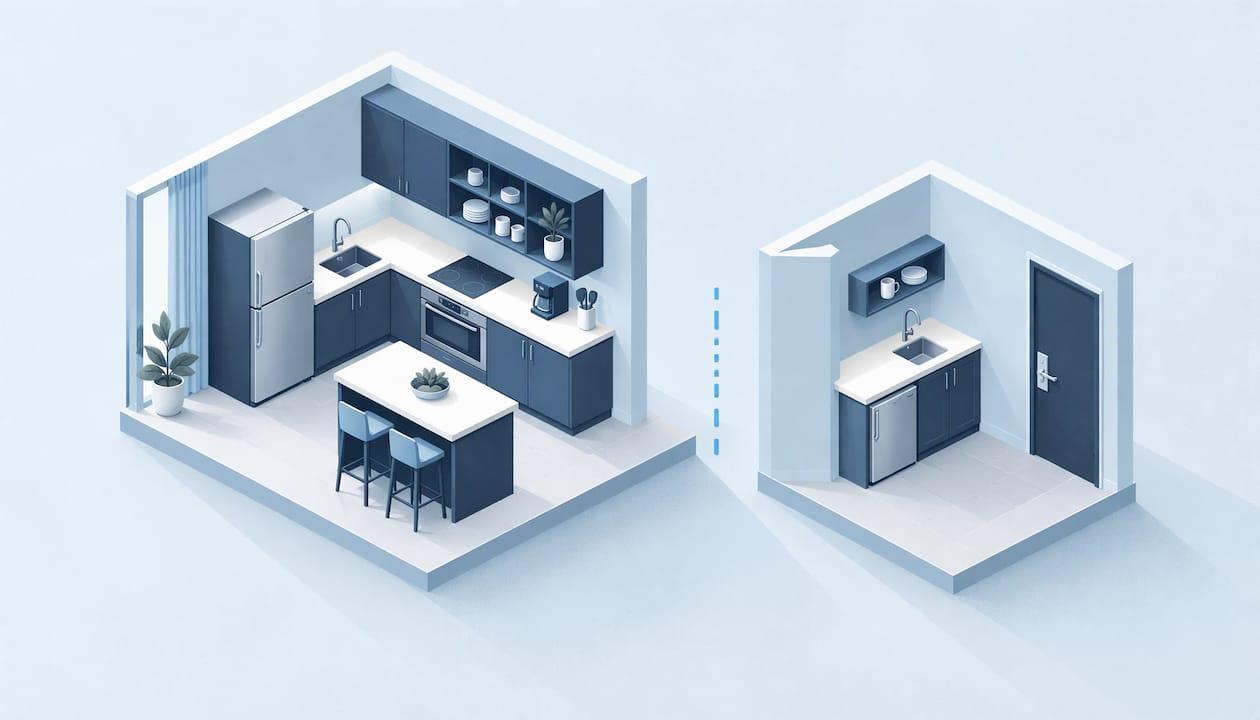
You booked a room for its kitchen, and you arrive to find a microwave on a dresser, or nothing at all. The fix is the same whatever the cause: check the room before you unpack, record what is missing, tell the hotel in writing the same day, and ask for a specific remedy. The best way to avoid the problem is to book a room whose cooking surface has already been verified at room level, which is how we list every hotel at Hotelkitchens.
TL;DR
- Inspect the kitchen before unpacking, and photograph or film anything that differs from the listing.
- Tell the front desk right away, then put the complaint in writing and keep a copy. If you booked through a platform, notify it too.
- Ask for a concrete remedy: a corrected room, a different room with a kitchen, a price reduction, a refund or a credit.
- Keep the listing, the confirmation, your messages and a timeline in one place in case you need a card dispute or a consumer complaint.
- Next time, book from a source that shows room-level kitchen evidence and confirms a real cooking surface, not just a microwave.
Table of Contents
- What "not as advertised" means for a hotel kitchen
- The first hour: what to do before you unpack
- The evidence file: what to keep
- Who to tell: the hotel first, the platform second
- What to ask for
- If the hotel says no
- How to avoid the problem next time
- Start from rooms already verified
- FAQ
- Sources
What "not as advertised" means for a hotel kitchen
A kitchen problem rarely looks the same twice. Sorting yours into one of three types tells you how strong your complaint is and what to ask for.
The kitchen is missing. The listing said "kitchen" or "kitchenette" and the room has a mini fridge and a microwave at most. This is the clearest mismatch, because the cooking facility you paid for does not exist.
The kitchen is partial. Words like kitchenette cover a wide range. Some rooms have a two-burner cooktop, a full-size fridge and a sink. Others have a sink and a small refrigerator and little else. Our guide to what a hotel kitchenette actually means shows how far the term stretches, and the guide to hotel kitchen appliances explains which appliances you can reasonably expect. If the listing named a stove, oven or cooktop and the room lacks it, that is a mismatch, not a matter of interpretation.
The kitchen is there but does not work. A burner that will not heat, a fridge that does not cool, missing or broken dishes. This is usually a repair request first, and a complaint if it is not repaired promptly.
The vaguer the listing wording, the harder the argument, which is why the evidence you gather in the first hour matters so much.

The first hour: what to do before you unpack
The order matters. Most consumer agencies give the same advice: find the problem early and report it early.
1. Check the kitchen before you settle in
The European Consumer Centre in Finland advises checking a room with a kitchen before unpacking, looking at the dishes and appliances, and promptly reporting anything that does not work or is broken. Turn on each burner. Open the fridge. Count the plates, pots and utensils. This takes five minutes and gives you a clean starting point, because anything you report after a few days of cooking is easier for a hotel to dispute.
2. Photograph and film the mismatch
Take wide shots that show the whole room, then close shots of the spot where the kitchen should be or of the broken appliance. A short video that walks through the room is useful because it shows the layout. The French European Consumer Centre's 2026 guidance suggests photographing or filming the mismatch and trying to resolve it before you leave, including booking alternative lodging if needed.
Then capture the other side of the comparison. Screenshot the listing as it stands right now: the room name, the amenity list, the photos and any text that mentions a stove, cooktop or kitchen. Listings get edited after complaints, so save it today. The same habit helps with any rental or lodging listing, for example a vacation rental listing page where the property details and amenities are published in one place and a guest can compare them with what they find on arrival.

3. Tell the front desk, calmly and specifically
Go to reception, not the phone in the room, and say exactly what you booked and what is missing. For example: "The room I booked is listed with a cooktop and full-size refrigerator. This room has a microwave and a mini fridge. I booked it for cooking, so I need a room that matches the listing." Name the remedy you want. Asking for a specific outcome gets a faster answer than describing how disappointed you are.
Note the name of the person you spoke to and the time. If the hotel offers another room, ask to see it before you agree, and check that it has a real cooking surface, not just another microwave.
4. Put it in writing the same day
The Finnish consumer center says that if the problem is not fixed immediately, you should make a written complaint on the spot and keep a copy. An email to the hotel's reservations address, with your photos attached and your booking number in the subject line, does the job. Keep it short: what the listing promised, what you found, what you asked for, and when you spoke to staff.
The point of the written complaint is the timestamp. Denmark's consumer authority reported in 2025 that package-travel customers risk losing compensation when they complain too late or cannot document the complaint, and it recommends writing the complaint and keeping photographs. That finding concerns package trips in Denmark, but the lesson travels: a prompt, written, documented complaint is stronger than a verbal one made at checkout.
The evidence file: what to keep
Build one folder on your phone, with these items in it:
- Your booking confirmation, with the room type and booking number.
- A screenshot or saved page of the listing, including the amenity list and photos.
- Your photos and video of the room as you found it, with timestamps.
- Every message with the hotel and, if relevant, the booking platform.
- A simple timeline: when you arrived, when you inspected, who you told and when, what they offered.
- Receipts for extra costs that follow from the problem, such as restaurant meals you had planned to cook yourself or a night in other lodging.
Ireland's consumer regulator, the CCPC, advises guests to keep a record of correspondence and take photos to support a complaint. It also states that accommodation must have the features promised at booking and match its description, whether that description was online, in a brochure or in an advertisement. That is Irish consumer guidance, and your rights in the United States depend on your state and your contract, but the evidence you need is the same everywhere.
The receipts deserve a note. If you are a family that planned to cook breakfasts and dinners, the grocery savings were part of why you chose this room. Keep restaurant receipts for the meals you had to buy instead. They show the real cost of the mismatch when you ask for compensation.
Who to tell: the hotel first, the platform second
The hotel is the first call, because it can fix the problem on the spot by changing your room. The CCPC says a guest who booked through an intermediary should first try to resolve the issue with the hotel or host, and should also tell the platform promptly, since it may be involved in processing a refund.
So if you booked through an online travel site or a booking partner:
- Raise it with the hotel at the front desk and by email.
- Open a case with the platform the same day, attach the same photos and screenshots, and refer to the hotel's reply.
- Keep every reply in writing. If a phone call is the only option, follow it with an email that summarizes what was said.
If you paid the hotel directly, the hotel is your only counterpart, and your written complaint to it carries the weight.
What to ask for
Not every kitchen problem deserves a refund, and asking for the right thing gets better results. The French consumer center lists the usual options: repairs, another available room, compensation, a price reduction, a future-stay credit or another suitable solution depending on the problem.
Here is how that maps to the three problem types:
| Problem | First ask | If the hotel cannot deliver |
|---|---|---|
| Kitchen missing | A different room with the listed cooking facilities | Price reduction, or cancel and refund for the nights you will not stay |
| Kitchen partial (no cooktop, no oven) | The room type that includes what the listing named | Price reduction that reflects the missing features |
| Kitchen broken or no utensils | Repair or replacement the same day | Reduction for the days it stays broken, plus meal costs |
Spain's European Consumer Centre recommends demanding the contracted room features, seeking a price reduction, or claiming a refund if the property refuses to provide what was agreed. Consumer guidance in Australia, reported by ABC News from CHOICE advice, draws a line between a major failure and a minor one: a major failure is one that would have stopped you booking, cannot be fixed in a reasonable time or is unsafe, and it allows you to cancel for a refund or keep the room and negotiate a lower price. A missing stove in a room you booked for cooking fits that logic in everyday terms, though the legal test depends on where you are.
In the European Union, the Package Travel Directive covers package trips and linked arrangements, not every standalone hotel booking. Where it applies, a traveler may terminate without a fee if the non-conformity substantially affects the package and the organizer fails to remedy it. If you are in the US, treat these as examples of how regulators think, and check your own state's rules.
Moving rooms or leaving
If the hotel offers a different room, accept it only if it matches the listing. Ask for the change in writing, or confirm by email that you are moving because of the missing kitchen and that the rate stays the same or is reduced. If no room with a cooktop is available, you may decide to leave. Tell the hotel in writing that you are leaving because the room does not match what you booked, and keep the receipt for any replacement lodging. Do this only after you have told them and given a chance to fix it. Leaving without notice weakens your position.
If the hotel says no
Do not escalate before you have your file. When you do:
- Your card issuer. Check your card account's dispute procedures. Billing disputes can follow different paths depending on the problem, so read what your issuer asks for. Your booking record, listing screenshot, photos and message timeline are the evidence they will typically want.
- Travel insurance. If you bought a policy, read what it says about accommodation that differs from what was booked, and contact the insurer promptly.
- Your state's consumer protection office. State agencies publish their own lodging guidance. Wisconsin's consumer protection department, for instance, publishes reservation guidelines for lodging. Search for your state's attorney general or consumer protection office to file a complaint about a misleading listing.
Keep your tone factual in all of these. A clean file, a clear timeline and a specific request are what get a complaint resolved.
Why we verify the cooking surface, not just the word "kitchenette"
Most kitchen disappointments start with a word that means different things to different hotels. A listing says kitchenette and a guest imagines a cooktop, while the room has a microwave.
That is why we built Hotelkitchens around one standard. Every room we publish is checked for a cooking surface by both a person and an AI model, and the evidence is shown on the listing. A microwave alone does not qualify. When you can see which room type has the cooking amenities, you book that room type, and the surprise at check-in is much less likely.
We built it for families who plan to cook breakfasts, for business travelers on long stays, and for anyone who wants to spend less on meals. Those guests are exactly the ones a missing stove hurts most.
Ross
How to avoid the problem next time
A complaint is a repair job. A good booking process is better, and it takes about ten minutes.
- Book a specific room type, not a hotel. Hotels often have a mix of rooms, and only some have kitchens. The room name on your confirmation should include the kitchen or kitchenette wording.
- Name the appliance you need. If you plan to cook real meals, you need a cooktop, not only a microwave. Our guide on how to confirm a hotel room has a stove shows what to look for in listings and what to ask.
- Ask in writing and keep the answer. Wisconsin's consumer protection department advises asking reservation questions and requesting the information in writing, including confirmation of amenities such as appliances and kitchenettes. A short email asking "Does this room have a two-burner cooktop, a full-size refrigerator and cookware?" and a written yes is worth more than any phone call.
- Check what comes with the kitchen. Pots, pans and utensils vary widely. See what you actually get in the room before you plan a menu.
- Use a checklist. Our hotel kitchen checklist and the full walkthrough on verifying a hotel kitchen before you book cover the questions in order.
If you cook in the room, our guide to hotel kitchen safety covers the basics of using a cooking surface in a hotel room properly.
Start from rooms already verified
We list hotels with verified in-room kitchens and kitchenettes, with guest ratings and room-level kitchen evidence on each listing. Every room has been checked for a cooking surface by both a human and an AI model, so you can see which room type has the cooking facilities before you book. You can browse hotels with kitchens and kitchenettes, search by destination on our locations page, or read how we verify hotel kitchens.

If you are headed to the Midwest or the Pacific Northwest, we also have pages for hotels with kitchens in Minnesota, Michigan and Washington.
FAQ
Should I complain at the front desk or online first?
Go to the front desk first, ideally within the first hour, so the hotel has a chance to move you to a matching room. Then send the same complaint by email so there is a written record. If you booked through a platform, open a case there the same day.
Can I get a refund if the room has no stove but the listing said kitchen?
You can ask for one, and your chances improve when you have the listing screenshot, photos and a written complaint made promptly. Consumer centers in several countries list refunds, price reductions and room changes as possible remedies when a room does not match the agreement. What you are entitled to in the US depends on your state and the booking terms, so keep your file and ask in writing.
Is a microwave a kitchen?
A microwave and a mini fridge are not a cooking surface. If the listing promised a kitchen or named a stove or cooktop, the missing burner is the mismatch. For the range of what kitchenette can mean, see our guide to the term.
What if I only notice the problem after a few days?
Report it as soon as you notice, in writing, and explain why you did not see it earlier. Agencies warn that late complaints are harder to prove, so do not wait until checkout. Add the date you first used the kitchen to your timeline.
Sources
- Accommodation, European Consumer Centre Finland
- Travel accommodation and your consumer rights, CCPC (Ireland)
- How to cancel your accommodation booking? European Consumer Centre France
- Feriegæster klager for sent og mister erstatning, Forbrugerombudsmanden (Denmark)
- Consumer rights, European Consumer Centre Spain
- Your rights when you discover your hotel room is nothing like the ad, ABC News
- Directive (EU) 2015/2302 summary, EUR-Lex
- Home Lodging Reservation Guidelines, Wisconsin DATCP
- Vacation rental listing page example