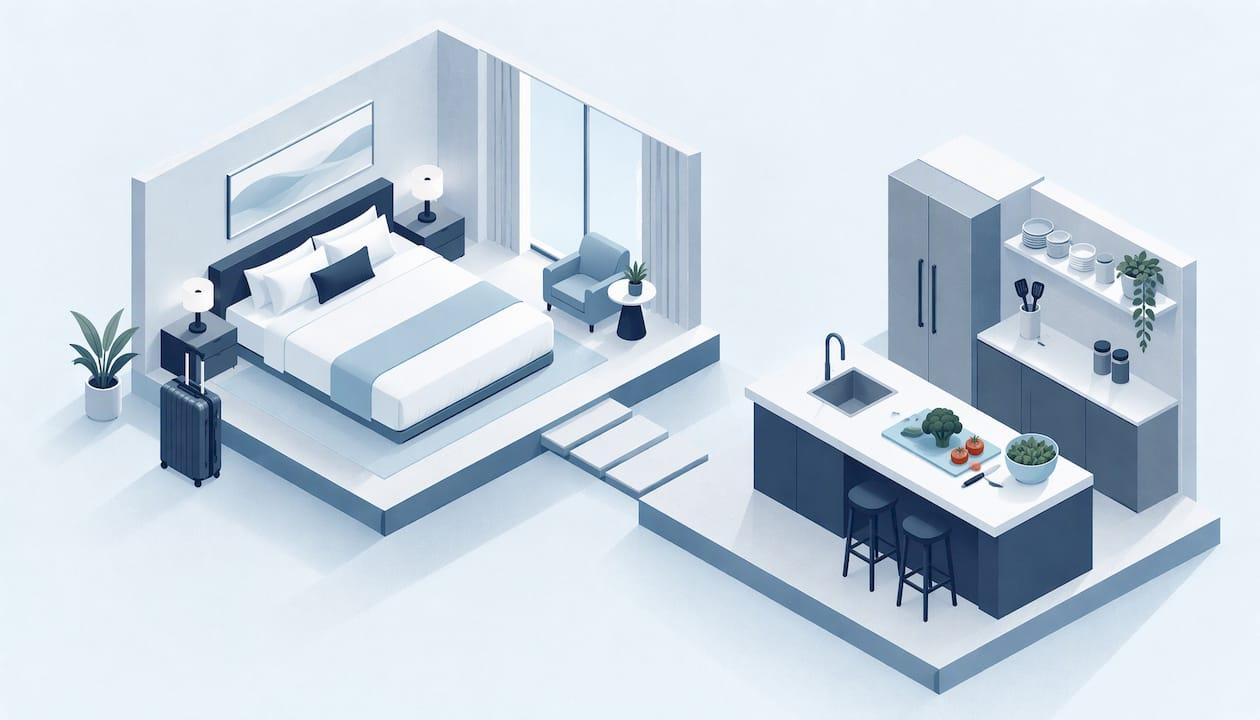
The safest hotel for a food allergy is one where you control what you eat: a room with a real kitchen or kitchenette, plus a manager who has answered your questions in writing before you book. Allergy organizations in the US, Canada and Australia all point to the same plan. Call ahead, think about self-catering, clean what you will touch, and carry your emergency medication. This guide walks through each step.
TL;DR
- Before booking, contact the hotel and ask to speak with the restaurant manager about allergy policies and whether they can provide safe meals (FoodAllergy.org).
- Allergy & Anaphylaxis Australia calls self-catering the safest option, so a room with a cooking surface and a refrigerator is worth prioritizing (source).
- Clean every surface you will touch, and use a detergent wipe, because hand sanitizer does not remove allergens (FAACT).
- Carry two epinephrine products in your hand luggage, and make sure everyone in your party knows the emergency plan on arrival (FAACT).
Table of Contents
- Why the hotel matters as much as the destination
- What to ask the hotel before you book
- Why a room with a kitchen is the strongest option
- Reducing cross-contact in your room
- Hotel breakfast buffets and restaurants
- Find a verified room with a kitchen
- Prepare for an emergency
- FAQ
- Sources
Why the hotel matters as much as the destination
A flight or a road trip is a few hours. A hotel stay is days of meals, shared surfaces and rooms that dozens of guests used before you. You depend on other people to tell you what is in the food and how it was prepared, which is the core risk FoodAllergy.org describes for travelers.
The top search results for this topic mostly talk about allergy-friendly rooms with air purifiers and hypoallergenic bedding. Those are useful for asthma and airborne triggers. For a food allergy, the questions are different: what is in the lobby snack basket, who cooks breakfast, can the kitchen avoid your allergen, and can you make your own meals when the answer is no.
What to ask the hotel before you book
Do this before you pay, not at check-in. Start planning early and use email so you have the answers in writing. FoodAllergy.org recommends this for international trips, and it works just as well at home (source).
Questions worth sending
- Who can I speak to about allergies? Allergy & Anaphylaxis Australia advises contacting the manager of the hotel or resort restaurant before booking to ask whether they can cater for your allergy (source). FoodAllergy.org adds that you should try to deal with the same manager every time you communicate with staff (source).
- Does the room have a kitchen or kitchenette? FAACT recommends notifying your travel provider and hotel of your allergies, including requests for special meals and rooms with kitchenettes (source).
- What does the room contain? One allergy blogger suggests asking what allergens are kept in each room, and whether the hotel offers room service, breakfast, or a restaurant that serves your allergen (source). Ask about in-room snack bars too. Food Allergy Canada advises being aware of them and keeping children away from unsafe items (source).
- Can you provide a refrigerator? Some hotels offer kitchen units or rent small refrigerators, according to AllergyHome.org's travel handbook.
- Where is the nearest grocery store? If you plan to cook, the same handbook advises finding out where the closest store is.
Hotels usually have 24-hour reception staff. Allergy & Anaphylaxis Australia notes they can help in an emergency, suggest suitable restaurants and point you to nearby supermarkets or fresh food markets (source).
Do not assume one safe restaurant means all are safe
At a resort or hotel with several places to eat, ask about ingredients and preparation at every restaurant, café and snack shop, every time. FoodAllergy.org specifically warns against assuming that because one eatery is safe, the others are (source).
Why a room with a kitchen is the strongest option
Allergy & Anaphylaxis Australia says self-catering is the safest option for people with a food allergy (source). ASCIA, the Australasian allergy society, likewise suggests considering self-catering accommodation so you can safely prepare your own food (source). In the US, FAACT's travelers checklist recommends reserving a room with a kitchen, microwave and refrigerator if possible (source). Food Allergy Canada points to a kitchenette or a refrigerator and microwave as features that suit an allergic traveler's needs (source).
Kitchen, kitchenette or just a microwave?
The difference matters. A microwave and mini-fridge let you reheat safe food you brought. A cooking surface lets you cook from scratch: eggs, rice, pasta, a simple dinner for the family. Healthline's family travel article suggests booking a hotel or rental with a kitchen, and requesting a small fridge and microwave if a kitchenette is not available (source). It also mentions a collapsible slow cooker or kettle for heating your own food.
| Room setup | What it lets you do | Best for |
|---|---|---|
| Full kitchen or kitchenette with cooking surface | Cook from scratch, store groceries, wash your own dishes | Longer stays, families, severe or multiple allergies |
| Refrigerator and microwave only | Store and reheat safe food you brought or bought | Short stays, simple meals |
| No kitchen facilities | Rely on restaurants, delivery, packed food | One or two nights, with advance calls |
Make the kitchen safe before you cook
A kitchen someone else used is not automatically clean of your allergen. Allergy & Anaphylaxis Australia advises checking the kitchen facilities and making sure cooking equipment, crockery and cutlery are clean before use (source). The next section covers how.

Reducing cross-contact in your room
Cross-contact happens when an allergen transfers from one surface, utensil or hand to a safe food. It does not take much. FoodAllergy.org states that an allergen cannot be removed from a meal once it is there, and that even a trace makes a food unsafe.
Arrival routine
- Wipe the high-touch surfaces. One traveler with food allergies recommends wiping light switches, door handles, tables, remote controls, stove buttons, and the microwave and refrigerator doors and shelves, and says this takes roughly 15 to 20 minutes (source).
- Use the right wipe. FAACT advises a wipe containing a commercial detergent, or a spray-on detergent with vigorous wiping. It notes a 2004 study found dish soap did not remove peanut allergen, and that hand sanitizing gel is not enough (source).
- Wash what you will cook with. FoodAllergy.org advises washing utensils, cutting boards and pans with soap and water before and after use (source).
While you cook
- Read every label before you start, every time. FoodAllergy.org warns that the same product made in another country may not have the same ingredients (source).
- Use separate utensils and dishes for allergy-safe food, cook it first if you are making several dishes, and keep it covered and away from other foods (source).
- If you touch an allergen, wash your hands with soap and water before touching anything else. Sanitizer or water alone will not do it (same source).
What to pack for the kitchen
FAACT's checklist suggests bringing allergy-friendly cleaning detergent, cooking utensils and kitchen supplies, sheets and pillow covers, hand wipes and extra safe food in every bag (source). For international trips, FoodAllergy.org suggests non-perishables such as dried pasta and allergen-free snack bars (source).

Hotel breakfast buffets and restaurants
Buffets are the hardest meal to control. Shared tongs, spoons that migrate between dishes, and open trays make cross-contact easy. One allergy blogger notes that hotels and motels often have peanuts and other top allergens in lobby sales or in the breakfast offering (source). Another parent-focused source observes that a breakfast buffet can be wonderful or a disaster depending on your child's allergens.
A safer approach for restaurants and breakfast service:
- Carry written allergy cards. FAACT advises always bringing instruction cards listing your or your child's allergens, and asking to speak with the chef or manager (source). Abroad, FoodAllergy.org recommends chef cards in English and in the local language (source).
- Ask for separate equipment. Request utensils, pots, pans, plates and preparation surfaces that have not touched your allergen.
- Send back a wrong dish. If a dish arrives containing the allergen, FAACT says to ask for a separate one and keep hold of your plate until the new one is prepared.
- Call ahead. FAACT suggests phoning restaurants and hotels before travel to learn which can safely accommodate you, and recording the acceptable ones on its traveler's checklist (source).
If the buffet is not safe for you, a kitchenette lets you have breakfast in the room and skip the buffet entirely.
Our perspective: verify the cooking surface, not the brochure
We built HotelKitchens around a simple observation. Travelers with food allergies keep being told to "book a room with a kitchen," but listings are vague. A microwave in a room photo is not a place to cook dinner.
That is why every room we list is checked for a cooking surface by both a human and an AI model, and we show the evidence on the listing. We publish only rooms that meet one kitchen standard, so you can see which room types have cooking amenities rather than guessing from a hotel-level amenity list.
For a family managing allergies, that means fewer unknowns before you arrive. You still need to ask the hotel your allergy questions and clean the space, but you start from a room built for cooking your own meals.
Ross
Find a verified room with a kitchen
If you want to cook your own meals, start with hotels with verified kitchens and kitchenettes. Each listing shows guest ratings and room-level kitchen evidence, and you can read how we verify hotel kitchens before you choose.

Planning a specific trip? Browse by destination on our locations page, or look at cities such as Chicago and Honolulu. Once you pick a room, still send the hotel your allergy questions in writing.
Prepare for an emergency
Severe reactions are why the planning above matters. These steps come from allergy organizations and apply to your doctor's plan, not instead of it.
- Carry your medication. FAACT says to carry two epinephrine products, other required medicines, a doctor's note, back-up prescriptions, insurance cards and signed copies of your emergency plan, and not to check medications in luggage (source). ASCIA adds that adrenaline devices should stay with you or under the seat in front on a plane (source).
- Brief everyone on arrival. FAACT recommends that the whole party knows how to reach local emergency services (911 in the US), how the call will be made, for example from a mobile phone or through hotel reception, and where the medications are kept. It suggests rehearsing it like a fire drill: who gives epinephrine, who calls, who rides to the hospital.
- Know the nearest hospital. FoodAllergy.org advises locating it before you arrive, and finding out whether local doctors specialize in allergy, for international trips (source).
- Check insurance abroad. Food Allergy Canada notes that laws and policies differ between countries, and suggests health insurance if your current policy does not cover claims outside your country (source).
Talk to your allergist before you travel about your emergency plan and prescriptions.
FAQ
Is a hotel with a kitchenette really safer for food allergies?
Allergy organizations describe self-catering as the safest option, because you choose the ingredients and control preparation (source). You still need to clean the kitchen and read labels, but you avoid relying on a buffet or a busy restaurant kitchen for every meal.
What should I say when I call a hotel about my allergy?
Ask to speak with the restaurant manager. Name your allergen, ask whether they can provide safe meals, and ask about breakfast, room service and in-room snacks. Follow up by email so you have the answers in writing, and ask for the same contact each time (FoodAllergy.org).
Can I rely on a microwave and mini-fridge alone?
They help you store and reheat safe food you brought, and FAACT includes them in its checklist. A cooking surface gives you more options for fresh meals, which is why we focus on rooms where one is confirmed.
Is hand sanitizer enough to clean a hotel table or counter?
No. FAACT says hand sanitizing gel does not remove allergens, and recommends a detergent wipe or spray with vigorous wiping (source). Use soap and water for hands.
Sources
- Accommodation when travelling with food allergy, Allergy & Anaphylaxis Australia
- Travel, AllergyHome.org handbook
- Travel, Food Allergy Canada
- All-Inclusive Resorts, FoodAllergy.org
- Tips for International Travel, FoodAllergy.org
- How to Avoid Cross-Contact With Food Allergens, FoodAllergy.org
- Travelers Checklist, FAACT
- Traveling, FAACT
- Avoiding Cross-Contact, FAACT
- Travel Checklist for Anaphylaxis, ASCIA
- Food Allergies and Family Travel, Healthline
- Managing Food Allergies in a Hotel Setting, InvisiblyAllergic.com