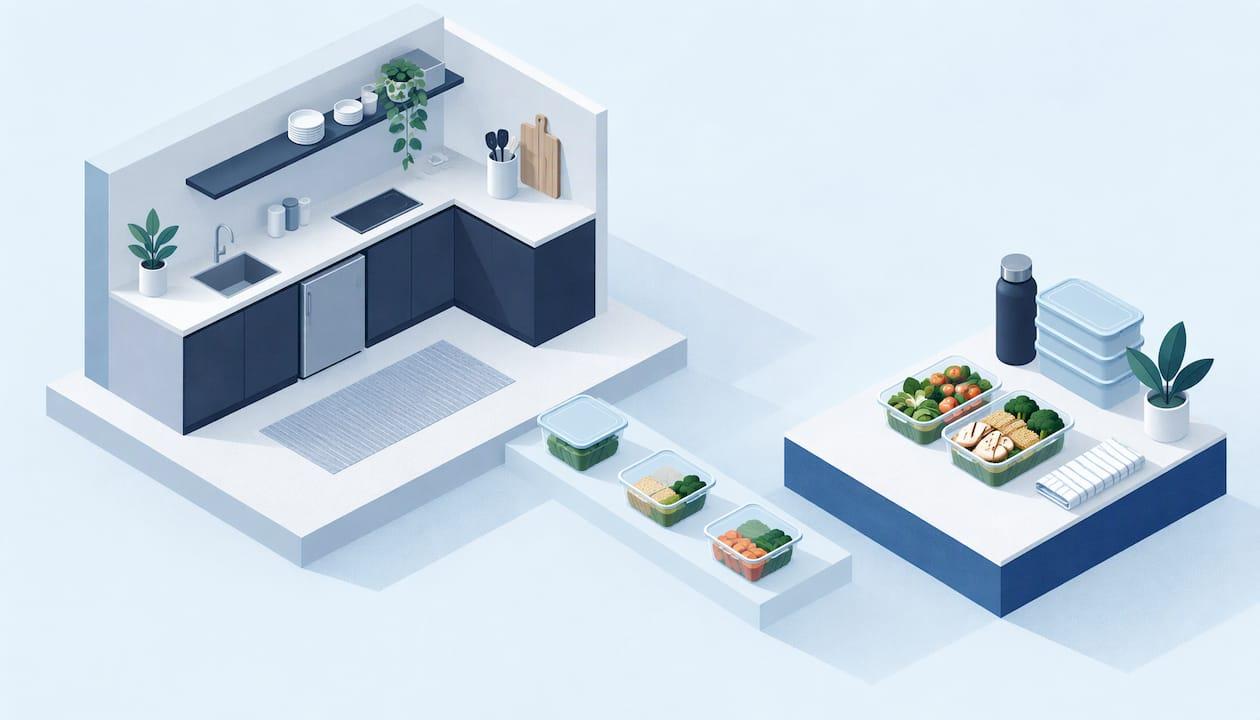
The easiest way to meal prep in a hotel is to book a room with a real cooking surface, a full-size fridge and a sink. Prep with only a mini fridge and a microwave is possible, but it limits you to assembling and reheating. We built HotelKitchens around that difference: each listed room is checked for a cooking surface, not just a microwave, so you know what you can prep before you book.
This guide covers both situations. You get a five-day plan, the gear worth packing, the storage rules that keep food safe and the room checks that save you from surprises.
TL;DR
- A room with a cooktop and a full fridge lets you cook in batches. A microwave and mini fridge limit you to assembly and reheating.
- Keep cold food at 40°F or below, and refrigerate prepared food within 2 hours (1 hour if it is above 90°F).
- Eat refrigerated leftovers within 3 to 4 days. Freeze the rest for later in the week.
- Pack a small kit: a sharp knife, containers with lids, oil, spices and dish soap. Hotels rarely supply them.
- Check the room's actual equipment before you book, then plan the menu around it.
Table of Contents
- What hotel meal prep actually means
- Start with the room, not the recipe
- A five-day plan for a room with a cooktop
- What you can prep with only a microwave and mini fridge
- What to pack and what to buy there
- Food safety for hotel meal prep
- Check these before you cook
- How much meal prep can save
- Find a room that is ready for meal prep
- FAQ
- Sources
What hotel meal prep actually means
Meal prep is cooking or assembling food in advance so that most meals need only reheating or a few minutes of work. At home that means a Sunday batch of chili and rice. In a hotel, the same idea has two versions.
The first is cooking prep: you buy groceries, cook two or three base dishes in the room and portion them for the coming days. This needs a cooktop, a sink and a fridge with room for containers.
The second is assembly prep: you buy ready or near-ready foods and combine them. Think overnight oats, wraps, salads from kits, yogurt cups and rotisserie chicken portioned into boxes. This works with a microwave and a mini fridge.

Most travelers who search for this are in one of three spots: a family on a week-long trip trying to avoid three restaurant meals a day, a business traveler staying Monday to Thursday for weeks, or a budget traveler who wants to cut the food line of the trip. All three do better with the first version, and that is a booking decision, not a cooking one.
Start with the room, not the recipe
The equipment in the room decides the menu. Here is how the common setups compare.
| Room setup | What you can prep | Main limit |
|---|---|---|
| Microwave and mini fridge | Overnight oats, wraps, salad kits, microwave eggs, reheated frozen portions | No browning or simmering, little cold storage |
| Kitchenette with two burners, microwave, full fridge | Pasta, rice, stir-fries, chili, soups, sheet-pan style batches in a skillet | Small counter, few pots |
| Full kitchen or suite | Everything above, plus oven roasting and larger batches | Starter cookware may not cover your recipes |
A word of caution about the word "kitchenette." It can mean a two-burner cooktop and a full fridge, or it can mean a microwave on top of a mini fridge. Our guide to the hotel kitchenette meaning explains the range in plain terms.
That is the gap we close. Every room in our directory is verified to have a cooking surface by both a human and an AI model, and the evidence is shown on each listing. Only rooms that meet one kitchen standard are published, so you see which room type has the cooktop. You can browse hotels with kitchens and kitchenettes by destination and read guest ratings alongside the kitchen evidence. You can also read how we verify hotel kitchens.
Extended-stay style suites commonly include a full-size refrigerator with a freezer, a two-burner electric or induction cooktop, a microwave and a sink, according to a 2026 extended-stay cooking guide. That is the setup that makes batch cooking realistic, and it is the type we look for.
A five-day plan for a room with a cooktop
The goal is to cook once or twice and eat well for the whole stay. Here is a worked example for one adult, Monday to Friday, built on two cooking sessions.
Day 1, evening (cook session one, about 45 minutes):
- Brown ground turkey or beans with onion and canned tomatoes in one pot to make chili. Cook rice in a second pot or in the same one after.
- Cool the chili in shallow containers, not one deep pot, so it chills quickly.
- Portion three servings of chili and rice. Put them in the fridge within 2 hours of cooking.
- Freeze two servings of chili in a separate container for later in the week.
Day 2 or 3 (cook session two, about 30 minutes):
- Sauté a bag of frozen or fresh vegetables with garlic and a protein such as chicken thighs or tofu.
- Add a store-bought sauce, serve over the remaining rice and portion two lunches.
Breakfasts and snacks (no cooking): overnight oats in jars, boiled eggs from session one, fruit, yogurt and nuts.
Result: roughly five lunches and dinners ready or nearly ready, with only two sessions at the stove. Add fresh salad kits or a rotisserie chicken for variety. If you want more ideas to rotate in, our guide to easy meals in a hotel room works for any setup, and meal prep while traveling covers trip-length planning. For recipe inspiration built around short cooking times, these quick weeknight dinner ideas show how to plan around what you already have.
Why two sessions, not one
Cooked food that sits in the fridge for more than a few days loses its safety margin. The USDA says leftovers keep 3 to 4 days in the refrigerator and stay safe indefinitely when frozen. Cooking twice, and freezing what you will eat late in the week, fits those limits without guesswork. Freezing needs a freezer compartment, which many mini fridges lack, so check that in advance.
What you can prep with only a microwave and mini fridge
Sometimes the room is what it is. Assembly prep still works, and the trick is to choose foods that need cold storage in small amounts and heat quickly.
- Overnight oats: oats, milk or yogurt and fruit in a lidded jar. Make three at a time.
- Wraps and sandwiches: rotisserie chicken, hummus, greens and cheese. Build them the morning you eat them so they do not go soggy.
- Microwave baked sweet potatoes: Food Network features a loaded version that cooks in the microwave in about 7 to 9 minutes with bacon, topped with cheese, sour cream and chives.
- Mug mac and cheese, quesadillas and soba or udon noodles: the same article lists these as simple options for a microwave and fridge room.
- Shelf-stable staples: instant rice pouches, canned beans, tuna pouches, peanut butter and whole-grain crackers.
Better Homes & Gardens collects ten recipes for a microwave and fridge only, including microwave eggs and lemon-pesto pasta, which is useful if you are stuck with that setup.
An electric kettle, if the room has one, widens the options. Kosher.com's hotel cooking tips note that a kettle can make instant oatmeal, ramen, instant mashed potatoes or couscous. Never leave any appliance running unattended.
What to pack and what to buy there
Hotel kitchens vary a lot in what they stock. Some rooms have a starter set of pots, a pan and plates. Spices and oil are rarely included, as that same extended-stay guide notes. Our article on hotel kitchen utensils goes through what you usually get in the room.
A compact kit that fits in a carry-on or a box in the trunk:
- A sharp paring or chef's knife with a sheath, and a small cutting board
- Two or three containers with tight lids, plus a few resealable freezer bags
- A silicone spatula, a large spoon and a can opener
- A small bottle of olive oil, salt, pepper and two or three spices you use constantly
- Dish soap, a sponge and a dish towel
- A cooler bag if you are driving
The University of Minnesota Extension's utensil list for cooking without a kitchen is similar: a large lidded container for washing dishes, a cutting board, a can opener, a colander, glass bowls with lids, measuring cups, a stirring spoon, hot pads, dish soap and a paring knife.
Buy perishables at a nearby store after you arrive. If you are driving, shop at your first stop for staples you cannot find on the road. Our grocery list by room setup matches what to buy to the equipment you have.
Food safety for hotel meal prep
Small fridges and unfamiliar kitchens make it easy to slip. These are the rules that matter most, and they come from US food safety agencies.
Temperatures and timing
- Keep the fridge at 40°F or below and the freezer at 0°F or below. The USDA Food Safety and Inspection Service says to refrigerate or freeze perishables, prepared foods and leftovers within 2 hours, or within 1 hour when the temperature is above 90°F.
- Cool food in shallow containers so the center chills fast.
- Reheat leftovers to at least 165°F. In a microwave, stir, cover and rotate the food so it heats evenly.
- Mind the danger zone. Bacteria can double in as little as 20 minutes between 40°F and 140°F, according to the USDA.
- Use a food thermometer or a fridge thermometer if you have one. A small mini fridge can run warm, so check that it is cold to the touch when you arrive and tell the front desk if it is not.
Ice, coolers and hands
If you use a cooler, the University of Minnesota Extension advises keeping cold food on ice and draining the water and adding fresh ice daily. The same page recommends washing your hands with soap for 20 seconds before preparing food and rinsing produce under running water without soap or bleach.
Raw and ready-to-eat foods
Store raw meat on the lowest shelf or in a sealed container, away from fruit, salad and cooked meals. Use a separate cutting surface for raw meat if you can, or wash the board with hot soapy water between uses.

Abroad
If you meal prep outside the US, the CDC's Yellow Book notes that fully cooked foods served hot and foods you prepare yourself are generally the safest choices, and it advises against raw or undercooked meat, fish, eggs and unpeeled raw produce. Cooking your own meals with a stove is one practical way to follow that. For a full set of habits, see our hotel kitchen safety guide.
Check these before you cook
A few quick checks make the stay smoother.
- Confirm what the room has. Look for a cooktop, a sink, fridge size and whether there is a freezer compartment. Rooms listed with kitchen evidence remove most of the guesswork.
- Ask about house rules for cooking. Policies differ. Some properties welcome in-room cooking in kitchen-equipped suites, while others forbid it in standard rooms. Our guide to cooking in a hotel room explains what is generally allowed.
- Do not improvise with appliances not meant for cooking. Using a coffee maker or iron to cook food is a common internet tip, but hotels may not allow it, and heat, steam and smoke can set off alarms. A room built with a cooktop avoids all of this.
- Use the vent and keep steam and smoke low. Cook with a lid and avoid high-smoke methods like searing in a small suite.
- Be considerate. Strong-smelling meals and a messy sink are the quickest way to annoy neighbors and housekeeping. Wash up right after you cook.
- Find the nearest grocery store. A walkable store makes a mid-week restock easy.
How much meal prep can save
The savings depend on the destination and how often you would otherwise eat out, so we avoid a single number. The practical approach is to compare your usual restaurant spending per day with what a week of groceries costs where you are going. For a family of four eating three meals out each day, groceries for breakfast and one other meal commonly make a visible difference over a week. We lay out the math in saving money on travel food, and family vacation meals shows cheap dinners that scale to a crowd.
Our perspective
A recipe cannot fix a room that has no way to cook. Most hotel meal prep advice online starts after you have already booked, and then tries to squeeze dinner out of a coffee maker or an iron.
We start earlier. A traveler who plans to prep needs a cooking surface, a sink and fridge space, and they need to know which room type has them. That is why every room we list is verified by both a person and an AI model, and why the evidence is shown on the listing. A microwave alone does not meet our standard.
For a stay of more than a few nights, the room is the best meal prep tool you will pick. Choose it first, then pack a small kit and plan two cooking sessions. The rest is easy.
Ross
Find a room that is ready for meal prep
If you want to cook and not just reheat, start with the list of rooms that have a cooking surface. HotelKitchens is a searchable directory of hotels with verified in-room kitchens and kitchenettes, with guest ratings and room-level kitchen evidence on each listing.

Begin on the HotelKitchens home page, or go straight to a destination, such as Boston, Minnesota or Washington. The full list of locations shows everything we cover.
FAQ
Can you meal prep in a hotel room without a kitchen?
Yes, but it is assembly and reheating, not cooking. With a microwave and mini fridge you can make overnight oats, wraps, microwave eggs and reheated frozen portions. For more than a couple of nights, a room with a verified cooking surface gives you far more options.
How long does hotel meal prep last?
Refrigerated leftovers are best eaten within 3 to 4 days, according to the USDA. Frozen portions stay safe much longer. For a five-day stay, eat the fridge portions first and freeze what you will eat later in the week.
What are the rules for meal prepping?
Cool food fast in shallow containers, refrigerate within 2 hours, keep the fridge at 40°F or below and reheat to 165°F. Keep raw meat separate from ready-to-eat food. These come from the USDA Food Safety and Inspection Service.
What should I pack to cook in a hotel?
A sharp knife, a small cutting board, lidded containers, a spatula, a can opener, oil, a few spices and dish soap cover most needs. Rooms rarely supply oil or spices. See the full list in the packing section above.
Sources
- Food and Water Precautions for Travelers, CDC Yellow Book
- Cooking for Groups: A Volunteer's Guide to Food Safety, USDA FSIS
- Don't Flunk Food Safety This School Year, USDA
- Cooking without a kitchen, UMN Extension
- Meals for Hotel with Fridge and Microwave, Food Network
- How to Cook Great Meals on the Road, Better Homes & Gardens
- Hotel room cooking hacks, Kosher.com
- Can You Cook in Extended Stay Hotels?